See It Now: The Shell Game at the Microphone
As courts prepare to rule on Trump’s use of the Alien Enemies Act, this article explores how the administration uses Stephen Miller to deflect legal responsibility and test extreme claims in public.


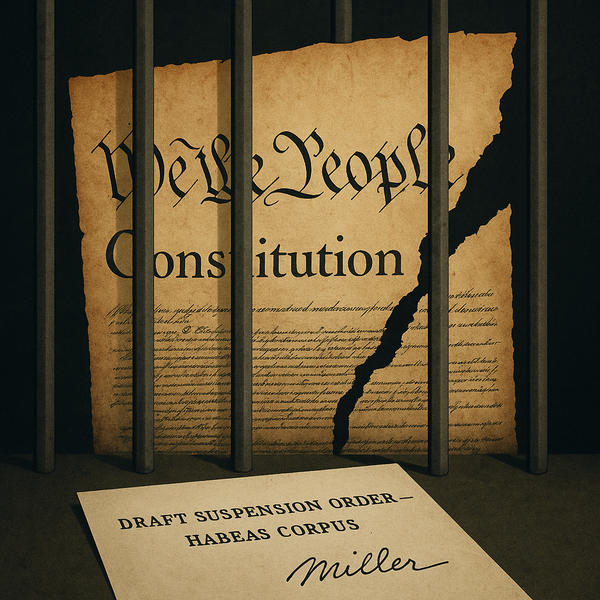
There is a reason the framers placed the Suspension Clause in Article I of the Constitution. They knew that no executive, no matter how self-righteous or emboldened, should ever hold the solitary power to strip people of their right to challenge unlawful detention. The power to suspend the writ of habeas corpus—the bedrock of due process—rests with Congress, not the president. And tonight, the nation should pay close attention to those who seek to bypass that distinction.
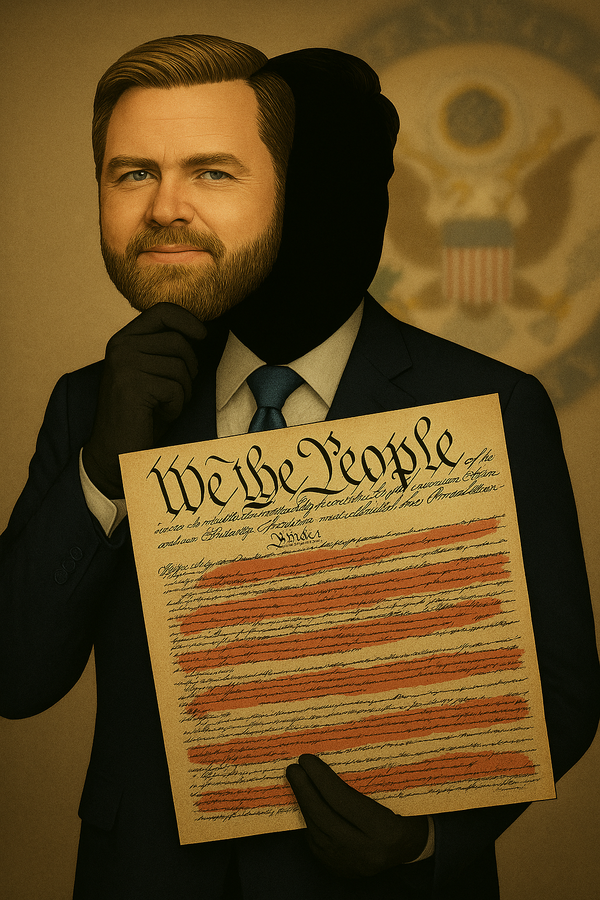
Yesterday, Stephen Miller, a senior advisor to President Trump, floated on C-SPAN the idea that the administration may consider suspending habeas corpus under the claim of an "invasion." He is not a lawyer. That, of course, is not incidental. His presence in the public sphere—delivering quasi-legal talking points about constitutional war powers and emergency authority—is no accident. It is strategy.
The Department of Justice, already under fire in multiple federal courts for violating restraining orders and deporting individuals under false pretenses (ABC News), cannot afford to make such legally indefensible statements on the record. So they send Miller, the ideological architect, to test the waters.
Let us be clear: this is not legal argument. This is not constitutional interpretation. This is rhetorical misdirection. A shell game.
What we now know, thanks to FOIA disclosures and judicial findings, is that the Trump DOJ used a pretext to invoke the Alien Enemies Act of 1798. The administration claimed that a Venezuelan gang, Tren de Aragua, was operating as an invading paramilitary force directed by a hostile government. Intelligence assessments now show this narrative was unsupported by classified data.
Judges in New York and Texas have ruled that the administration failed to provide any evidence tying deportees to gang activity. Habeas petitions are being fragmented and delayed. Planes were flown out of the country after federal restraining orders. The ACLU and legal scholars have labeled this strategy “flagrantly illegal.”
This is not just an abuse of law. It is contempt of court.
The D.C. Circuit has, for now, paused contempt proceedings to give the Supreme Court space to act. And the Court will act—likely in late June, with a majority led by Chief Justice Roberts. It is not just the Alien Enemies Act at stake. It is whether the judiciary will tolerate being openly defied by the executive branch. That is why Boasberg waits, Jackson drafts, and Roberts maneuvers.
The erosion of legal integrity is no longer theoretical. Inside DOJ, the structure is fraying. Career attorneys have reportedly refused to argue these cases, unwilling to defend legal claims they know to be fiction. Some have been reassigned. Others have quietly exited.
And as the New Yorker recently noted, this is not simply a legal debate. It is a constitutional crisis hiding in procedural shadows.
In the meantime, the administration places a non-lawyer in front of cameras to do what DOJ cannot: suggest, without consequence, that constitutional rights may be suspended. That habeas corpus is optional. That if the Court does not rule as desired, there may be other means.
This is not just posturing. It is a constitutional warning flare.
The question before us is whether we will recognize that flare for what it is—not a legal position, but a political threat. The strategy is clear: discredit the courts, float emergency powers, and blur the line between legal process and executive will. And it is precisely because the courts are beginning to reassert themselves that such deflections are now being deployed.
The judiciary is not perfect. But it remains the final defense against a presidency that no longer believes in constitutional boundaries. And in this moment, it is not enough to wait. It must rule.
Good night, and good luck.
Channeling Murrow’s voice for today’s America — not his words, but his principles.